Monday, 2 March 2015

Who Am I?

Image result for who am i?


Who am I?
A human or some being beyond?
Or not a being at all?

They say I am an Indian.
They say I'm born for my country,
They say I'm a Hindu, my religion,
They say I'm what I was meant to be...

A servant? A bird caged?
Bound by the bars of rules.
Submissive? A follower?
Held by the chains of society.

But that's not what I think I am,
My thoughts roam much beyond.
To the edges of this universe
To the beginning of this time.

Am I my mind?
Am I my soul?
Or just my body all along?
I wonder, is it just me,
Singing this song?

Am I alive? Or, am I lost
In a dream of my own?
Is this all my mind's creation?
If not, whose then?

Sure, in this world
Just a speck of sand in the desert.
But what power does my heart hold?
What magic does it wield?

Am I a real earthling?
In this boundless universe?
If not, I pray, I wonder,
Where is my real home?

Yes, home I seek
In many wanderings
To far, far away.
The abode, where my answer rests.
I close my eyes,
And seek even
To the edge of this world.

Saturday, 28 February 2015

Turning Points

Great stories have great people, great places and great sayings. Most important of all, great stories are the fruit of life-changing situations and aphorisms. Changing your life is changing your thoughts; what kind of an event is capable of bringing about such a change?

For most people, the answer may lie in suffering. The sight of a beggar on the street, starving, is the reason why many famous personalities chose the path of charity. For others, life may change with their Eureka! Moment, the excitement of learning something new. A small fragment of the crowd may find their answer in nature and the solitude it provides.

Nature provides solitude incomparable to
anything else
However, in my case, it is not the situation itself, but the events which led to the situation that pave the road for the change that is about to happen. These small events, however infinitesimal they may seem, have a significance that cannot be ignored.

The time which changed a person’s life might be when she had to suffer – live on small amounts of everything in a dilapidated old place or think even before buying a bar of soap. On tracing the path to its beginning, one may discover how small, everyday mistakes led to the poverty of this particular person.

On looking back, it is these mistakes which teach you to not commit them again, these small incidents which change your life. And when you review the whole thing instead of its result, which is merely a part of it, the change induced in you is a strong, determined change.

Every person has their own unique story detailing the turning point in their life. My story consists of not one, but numerous such turning points. Those life-changing moments are all the fifteen years of my life; each second of each moment teaches me something new, making me a better person with each passing minute. In retrospect, the two-years back me is so different from the present-me. The reason is that without us knowing, every single jiffy of our life span plays a role in changing us.

When I close my eyes and think of the water gushing and flowing fiercely down a cliff in a waterfall, it impacts my emotions and lets them flow, easing them. Whenever I’m angry or terrified, I just close my eyes and think of the waterfall, letting me control my emotions and thinking logically. This makes me a much changed person than before.

These little things crave to be noticed, wanting to play the part they deserve to change your life, because the events that led to my life changing situation, composed of such minuscule occurrences, have made me what I am today.

Tuesday, 3 February 2015

Recollections of Red Fort

Even from far away, a person taking a trip to Lal Quila, Red Fort, or originally known as Quila-i-Mubarak, can see the huge fortified structure of red sandstone set against the skyline behind the antique open rickshaws and unique architecture of Old Delhi.

Another historic trip, another travel post. Well, the Red Fort was one hell of an experience, just the perfect one if you want a short trip to a place where the history flows like a deep, flowing river. The Red Fort, along with its tumultuous history, is an eye candy for observing the art and architectural styles of the Middle Ages.

The reason the capital of the Mughals was shifted from Agra to Delhi was Shah Jahan's love for majestic processions, which proved futile in the congested roads of Agra. That majesty can be seen quivering in the heart of the Red Fort.

There's a fort, readied for defence, so, it's the next obvious choice to build a moat. As soon as one enters, the majestic fort rises up surrounded by a dried-up moat once full of crocodiles and piranhas. The moat must be about medium in width, which is compensated by the well-thought defence mechanisms on the fort walls. Basically, the wall is divided into three parts based on the height where slits are set against the sandstone, just enough for the archers to shoot. The slits widen as the height of the wall increases, and at the top, the enemies from far away can be easily ambushed by cannons, if not arrows.

The outer wall is the ultimate symbol of defence, as helmet-like structures can be seen carved on the top of the wall at regular intervals. Lots of things have happened in this particular place, filled by the feelings of Shah Jahan and his children, including Aurangzeb, Dara Shikoh, Jahanara, and Roshanara.

Shah Jahan, or Khurram, was a renowned lover of art and architecture, which can be seen in the pillars and domes. However, attached to this were wise battle strategies.

Chhatta Chowk


The entrance to the fort is adorned by the Delhi Gate, renamed by Aurangzeb as Lahori Gate. Then wafting comes the cool, pleasant air on your face as you enter the eminent Chhatta Chowk, the first covered market of North India. In those times, it was more like Shah Jahan's personal market where he used to buy his perfumes, carpets, and lavish adornments. People from as far as Persia came to sell their wares, and the balconies built beneath the roof were places for the people to view the king's procession.

Naubat Khana


Moving on, one can see a building built by the British to your left, the dull among the beautiful. There's a roundabout leading up to a just as old building and further on, most of the space is covered by lawns with colourful flowers here and there sending a sweet scent through the air. Next comes the Naubat Khana, where nagadas were beaten in a variety of tunes to send a variety of messages across Shahjahanabad, the sixth city of Old Delhi. On its first and second stories has been launched the Indian War Memorial Museum.

An intricate display of weapons, defensive equipment and old-age technology completes this fascinating museum. Swords of different hilts, shapes and edges, rifles with hundreds of types of bullets, the chainmail and  the shields are riddled with ancient history. The telephone, signalling system, pressure measurement system, fuses and bombshells (some a meter high), send shivers through one's body.

Diwan-i-Am


Stretching out in front of the Naubat Khana is a road leading to the Diwan-i-Am, the Hall of the people. On that road only the foot of a human was allowed, except for Dara Shikoh, for only he was allowed to ride up to the Hall on a horse.

The Diwan-i-Am is a brilliantly constructed open hall where every single spot is visible from the king's high throne, which is carved and printed with detailed designs of pietra dura. On both the sides of the throne are nets of marble behind which used to sit Jahanara (in the more majestic one) and Roshanara, to learn from the judgments of their father. A voice from one far end of the hall can be heard at the other far end of the hall, such is its built. On the edge of the roof hang hooks from where leather curtains were hung in the winter and khus curtains were hung in the summer.

One can see many turns along the way, which were aimed at slowing down the attacking army. Spotted at the side are a few British buildings one of which was built in place of a major part of the fort during the revolt of 1857.

Onwards appear lawns typically divided into four parts with water flowing in between the paths dividing the expanse. The Hayat Bakhsh Bagh is one of them. Then arrives the Moti Masjid, the personal mosque of Aurangzeb, who was too afraid to go pray in the Jama Masjid. Ahead of that is the Hammam, Shah Jahan's spa, where a hundred people worked (surprise much?)

Diwan-i-Khas
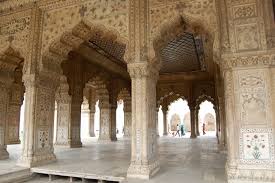


The Diwan-i-Khas dawns like the sun with its symbolic architecture singing of justice. On one of its walls is inscribed a taraju, an instrument for comparing weights, which clearly signifies equality in the face of the law. Inside, the pietra dura beautify the Diwan-i-khas to a divine extent.

A short passage of once-existing Yamuna water leads to the Khas Mahal, the residence of Shah Jahan ,and onwards to the Rang Mahal, the residence of the queens.

It is perhaps interesting to note that the bedroom of Shah Jahan, the Khas Mahal was honourably named the Khwaabgah, the abode of his dreams. The majesty of the thoughts of the people in those times surpass the ability of the most famed philosophers of the day.

Even more fascinating is the fact that the whole complex is shaped like a bow. The Yamuna which flowed in front of it, which has now changed its course, was the string, and the straight road leading to Jama Masjid was the skilled hand, imbibing power from God.

It's riveting to note that an equal part of the fort exists beneath it, in the basements, which were the refuge of the royalty during the hot summers. Unfortunately, the people aren't allowed to enter the area, so as to prevent spoiling the greatest architectural works of the age.

There are numerous great things about the Quila-i-Mubarak, the greatest being the intricate signs present in the smallest of things, signs which contain an infinite amount of history, complimented in between with melodies of symbolism and art. As one stands there, closing his/her eyes and opening them to reveal the surroundings re-winded to that enlightening age, the body feels vibrations, sending a message that history is much more than we believe. It's the inescapable reality.

Last but not the least, hats off if you managed to read this whole post. Hats off to you, man.

Sunday, 11 January 2015

What's in a Name?

All of us know that J.K. Rowling wrote a couple of books under the pen name Robert Galbraith to live a regular author's life, filled with low sales, a relaxed environment and rest. Unfortunately for her, it didn't work out and she was the subject of the media cameras and the adrenaline-filled literary bloggers who fell off their chairs hearing the news (high five if this happened to you too).

But, what's in a name? Can a two-worded phrase that takes up a minuscule amount of a page make such an impact? The thing's got power, you can't deny.

In the case of J.K. Rowling, it turns out that 'J.K. Rowling' isn't her exact real name either. That's got another story behind it. You see, Joanne Rowling, the author of Harry Potter, was afraid her books wouldn't sell that much if the people thought she was a woman. So, she added Katherine as her middle name, turning it to 'J.K. Rowling'.

I myself thought J.K. Rowling was a man till the age of ten. Although it does seem sad that she had to hide her gender while publishing, she was being realistic nonetheless, but that's another story.

Well, it's not just her, lot's of other authors and poets have used numerous pen names, looks like it had been a trend even a thousand years ago. It's curious that the author Ed McBain used no more than FIVE Noms de Plumes - Curt Cannon, Hunt Collins, Ezra Hannon, Richard Marsten and Evan Hunter. Keeping all these a secret is a bigger achievement than writing twenty books.

Some like William Makepeace Thackeray do use them as a joke. George Savage Fitz-Boodle? Michael Angelo Titmarsh? THÉOPHILE WAGSTAFF? Seriously, dude.

It is interesting indeed to find out that Benjamin Franklin didn't only create a pen name, he mapped out whole personalities of that particular name. His first pseudonym, Silence Dogood, was a widowed woman much older than him. The pen name Polly Baker was his alter-ego, used to show that women were discriminated against by the law (she had a much, much more exquisite tale behind her, but that's another story).

While some use pen names to escape a disappointed father, and some use them to evade a jail sentence, the stories behind them are fascinating. Turns out something as small as a name is VERY powerful (unless you count Albus Percival Wulfric Brian Dumbledore. PHEW.)

Therefore, when I sit down and think for a suitable pen name for myself, I can think nothing more serious than Jalebi Sweetsavage (people would love me, wouldn't they?) Of course, this fantasy person's got a different life history... but that's another story!

Thursday, 25 December 2014

You.

Those stars,
All bright
Beneath the sky.
The sickle-shaped
Moon, shining
Up nigh,
Are no match
For your infinite
Smile, wider
Than the sickle,
Brighter
Than the little
Spots up high. 

Those swirls
On a spring,
Spiralling out.
The waves
Sparkling, at
The river's mouth,
Are no match
For the depth
Of your eyes
Shading 
The sorrowed,
Mirroring
The sunrise.

Those heavens,
Abodes 
Of powers divine.
The paths
Through lands
With blossoms fine,
Are no match
For you, 
Your heart,
Vast as this
World,
Soothing as the
Harp.

Wednesday, 17 December 2014

Love Massacred at Peshawar

Before I ramble on, I would warn you this: This post might make you cry, feel bad, nauseous or heartbroken. It might take over your mind, or it might infest your dreams. But I shall also tell you this: this crying will make you learn, and this sorrow would fill you with pity. It is your choice.

The gruesome Taliban bombing has left the world dumbstruck. Shooting children, more than a hundred of them, aiming right in the head - this incident has brought the human race to the edge of a revelation - that the hearts no longer reside in their bodies.

With the shooting of a single child, a thousand dreams were shot. With the shooting of a single child, millions of ambitions were shattered. But most important of all, with the shooting of a single child, a precious life was lost, which can never be forgiven.

The Pak Taliban entered that hapless Pakistani school, no remorse, no pity, no emotion. Did they not see the eyes of that curious five year-old, wide open at the mysterious object in their hand? Did they not see that terrified face of the shocked girl, praying for her safety? Did they not see the determined face of that gracious girl, who knew death was to come?

Did they not see humanity in those faces? Did they not feel the tears in their eyes?

Such massacring of small, innocent children by a terrorist group has finally opened the world's eyes. These ruthless bringers of terror don't discriminate on the basis of age or condition, they just pull the trigger.

If the anger seeps from my heart, I might even feel pity for those terrorists.

If anyone from Pakistan is reading this post, know fully that the people of our country hold no grudges against you. We are with you all through this, for in the end, they weren't Indian children or Pakistani children, they were human beings, children of this world, and they deserve to live.

I'd like to share this with the Pakistani government - before thinking about issues like Kashmir, which do need to be resolved - think of how broken you are from the inside. Think of the 150 children who were killed.

And most important of all, think of justice, pity and love.

Thursday, 11 December 2014

Significance of the Small

Bonjour! It's been many days since I've mused on everyday things, but here comes another day filled with another one of my amusing musings.

Everyday things. Those really, really small, supposedly insignificant things fascinate you sometimes. The odd position of the things on your study table, the equal shapes of flower petals, the tiny ray of sunlight reflected from the tears of your eyes... small, but fascinating.

Sometimes, it's these small things which bring about life-changing revelations. A stream flowing in the bright sun may motivate you to follow your dreams. A shattering glass may inspire you to forgive. These things, hidden in the superficial, are of immense value and churn wisdom.

That's the reason small things of each day of our life must be contemplated, and never underestimated. 

These minuscule fragments of matter may create stunning realizations, but have you ever noticed that these fragments can bring about destruction? That an almost invisible microbe can bring about suffering? That some tiny nuclei fusing with each other can destroy an entire city?

This world has often been thought of as a place where we earn, eat and sleep. There's so much more than that. Luck, hope, emotion and the small, everyday things of life, those which are infinitely stronger than you, and constantly crave your attention.

Try giving it to them, and life will turn into a dream-like reality.